
Provincial News ? Amendments to O. Reg. 419 CofA Regulation
In June 2006, the OME posted a proposal to amend the regulation covering CofA applications, O. Reg. 419 (see Summer 2006 Bulletin) with a comment period extending to Sept., 2006. ? The OME revised and re-posted updated amendments in April, 2007 with a comment period that lasted until May 7th. ? Below are highlights of the proposed changes.
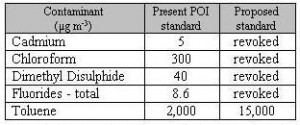
Changes to POI Standards
The June 2006 posting included proposed changes to Schedule 1, 2 and 3 standards. ? Schedule 1 standards apply to all facilities immediately (apart from new facilities falling under Schedule 4 and 5 classes). ? We concentrate on those, but interested readers may contact us for changes to 2 and 3 standards.

Schedule 2 updated 0.5 hr standards will apply in 2010 to most facilities, while Schedule 3 standards will apply to all facilities by 2020.
Proposed Action: All companies requiring Certificates of Approval (Air) should re-evaluate their compliance status using the proposed new and upcoming standards now.
Update to Schedule 4
Comments were submitted by the foundry sector indicating the sector s difficulty in meeting the new Schedule 3 standards with the new US EPA models by 2010, since many foundries are small- to medium-sized businesses.
The Ministry accepted the industry s comments and have begun a sector compliance initiative. ? They have also de-listed foundries from Schedule 4, thus obviating the need for foundries to comply with the new models and standards by 2010.
Regional Meteorological Data
The Ministry is considering revising the missing-data interpolation method in the meteorological records used as input into the new, more advanced, US EPA models that will come into force for many companies in 2010.
Many data are missing in records due to wind speeds too low to register on older anemometers. ? However, the low wind speed condition is also of concern as they can represent periods of elevated airborne concentrations.
Odour Issues
Odour assessments are subjective due to varied human responsiveness to odour impacts. ? The Ministry is considering introducing the concept of frequency of odour exceedances (in testing compliance) and also clarifying human receptors;? that is, where human activities regularly occur.
Other Provincial News ?Environmental Review Tribunal Case
A recent Tribunal, in the case of certain environmental groups versus Lafarge Canada Inc., held that the MOE must account for its own Statement of Environmental Values? (SEV) in issuing CofAs; in particular, the requirement to protect the overall ecosystem. ? Interestingly, this requires accounting for cumulative impacts; a requirement not met by the present impact assessment method of comparing emissions of each substances from each facility against single standards. ? For more information, see the ERT website (www.ert.gov.on.ca).
Possible Future Consequences: The Ministry may advocate a more holistic and cumulative impact assessment in future versions of air emissions regulations.
Federal News
Bill C-30: Canada s Clean Air Act ? Committee Report
On Oct. 19, 2006, Bill C-30 received the first reading (see Winter 2007 News Bulletin). ? The Act was sent to Committee in Dec. 2007 and the report published in Mar. 2007. ? Highlights of the changes proposed by the Committee include: emphasis on Canada s commitment to the Kyoto Protocol, identification of significant areas? vulnerable to toxic releases or that contain a significant volume of toxic releases (the Government will have the power to obtain any information deemed necessary for release of toxics into the area), and, the creation of air standards across Canada, divided into different zones. ? If air quality standards are not met in a particular zone, then air emission standards will be imposed on industrial emissions in the zone.
Turning the Corner: ? An Action Plan to Reduce Greenhouse Gases and Air Pollution?
Announced in April, this plan seeks to reduce industrial and other air emissions by 20-55% from 2006 emission levels by 2012-2015 for several industrial sectors including Alumina and Aluminium, Base metal Smelters, Cement, Chemicals, Electricity Generation, Forest Products, Iron & Steel, Iron Ore Pelleting, Lime and Oil and Gas.
The Federal Government will consult with stakeholders over several months culminating in draft regulations intended to be published in Spring, 2008, and finalize all regulations by 2010. ? As part of the process, the Government will require all (potentially) regulated industries to submit information on 2006 emissions.
 The laboratory is accredited by CALA to ISO/IEC 17025 for specific tests on the scope of accreditation.